


September 4, 2026
.jpg)
All You Need to Know About E-invoicing in the UAE
April 7, 2026
If you’re a business owner in the UAE, you’ve probably heard the term “E‑invoicing in the UAE” more than once recently. For some, the concept is already clear. But for many others, it still feels confusing, technical, or wrapped in jargon. This article is designed to change that. We’re going to break down every part of e‑invoicing in a simple, practical way; so, by the end, you’ll have a clear, easy‑to‑use cheat sheet for your business.
The UAE is moving toward a fully digital tax environment, and e‑invoicing is a major part of this transformation. Instead of sending PDF invoices, businesses will soon issue invoices in a structured XML format that can be validated, delivered, and reported automatically.
To understand the system, you only need to know three things:
- What e‑invoicing is
- What PEPPOL is
- What ASPs are and how they connect to PEPPOL
Let’s break it down simply.
What Is an E-Invoice?
An e‑invoice is a structured XML (simply the document extension like pdf, xls, doc, etc.) invoice, not a PDF or scanned copy. In the UAE, it must follow the PINT‑AE format.
This allows:
- Automatic validation
- Secure delivery
- Real time reporting to the FTA
What is PEPPOL
PEPPOL is a global e-invoicing network used in Europe, Singapore, Australia, and now the UAE. Think of PEPPOL as a digital highway that delivers invoices securely and instantly.
It ensures all invoices follow the same structure, no matter which software a business uses.
Why the UAE chose PEPPOL:
- Internationally recognized
- Highly secure
- Reduces VAT errors
- Supports automation
- Works for both local and global trade
What Is an ASP (Accredited Service Provider)?
An ASP is a company/software approved by the UAE’s Federal Tax Authority (FTA) to:
- Connect your accounting system to PEPPOL
- Validate your invoices
- Apply digital signatures
- Deliver invoices to buyers
- Report invoice data to the FTA
You cannot connect directly to PEPPOL yourself; you must use an ASP.
Think of an ASP as Your official gateway into the UAE e-invoicing system.
How PEPPOL and ASPs Work Together
Here’s the simplest way to understand it:
PEPPOL = The Highway
ASP = The Toll Gate
Your Invoice = The Vehicle
You cannot enter the highway (PEPPOL) directly. You must pass through a toll gate (ASP) that checks everything before letting you in.
Step‑by‑Step: How an E‑Invoice Flows in the UAE
1. You create an invoice in your accounting system. It generates a PINT‑AE XML invoice, not a PDF.
2. The invoice goes to your ASP. The ASP checks:
- Format
- VAT fields
- Digital signature
- Compliance with UAE rules
3. The ASP sends the invoice into the PEPPOL network. This ensures secure, standardized delivery.
4. The buyer receives the invoice through their ASP. Both sides must be connected to the network.
5. The ASP reports the invoice to the FTA. This supports transparency and reduces VAT fraud
Who Must Comply With E‑Invoicing in the UAE?
According to the latest UAE guidelines, e-invoicing is mandatory for all businesses involved in B2B and B2G transactions, whether VAT registered or not.
This includes:
- Mainland companies
- Free zone companies (unless specifically exempted)
- Large enterprises
- SMEs (in later phases)
If you issue invoices in the UAE, you will eventually need to comply.
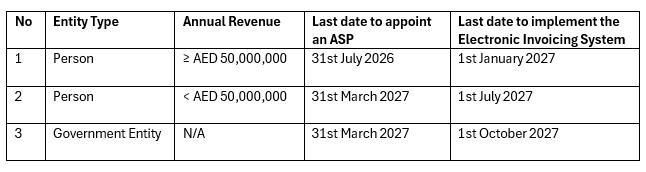
UAE E-Invoicing Timeline & Thresholds (2026–2027)
The UAE is rolling out e‑invoicing in phases. Here are the official thresholds and deadlines for Mandatory E-invoicing implementation.
Why E‑Invoicing Matters for Businesses
1. Faster invoicing: Invoices reach customers instantly.
2. Fewer mistakes: Standard formats reduce errors.
3. More secure: Invoices cannot be altered or faked.
4. Global compatibility: PEPPOL works internationally.
5. Better compliance: The FTA receives accurate data automatically.
What to Expect Now
E‑invoicing may seem like a major change at first, but once you understand the key elements such as PEPPOL, ASPs, the structured invoice format, and the UAE’s phased rollout, the entire system becomes much easier to navigate. The purpose of this shift is to simplify business processes, not complicate them. It brings accuracy, speed, security, and transparency into everyday transactions while helping companies stay aligned with the UAE’s digital tax direction. Whether your business falls under Phase 1 or will be included later in Phase 2, preparing early will ensure a smoother transition and stronger operational readiness. With the right understanding and the right tools, e‑invoicing becomes more than a compliance requirement. It becomes an opportunity to modernize your business and stay ahead of the curve.
For more information, reach out to our team of experts:
📧 info@one-centive.com
🌐 www.one-centive.com
📍 Office 508, The Binary by Omniyat, Business Bay, Dubai, UAE
Onecentive LLC-FZ is licensed under Meydan Free Zone, Dubai, UAE. This article is for informational purposes only and does not constitute legal or financial advice.
#EInvoicingUAE #PEPPOL #FTAUAE #UAEBusiness #TaxCompliance #DigitalTransformation #VATUAE #SMEUAE #Automation #FinTechUAE #BusinessTips #PaperlessBusiness
-
August 18, 2026


%203%20png.webp)